
The number of square feet in a baseball infield is not a single, fixed number because there are variations in its design and dimensions, especially when comparing different leagues like MLB, Little League, and softball. However, a standard MLB infield is roughly 17,500 square feet, and this calculation forms the basis for understanding the space involved.
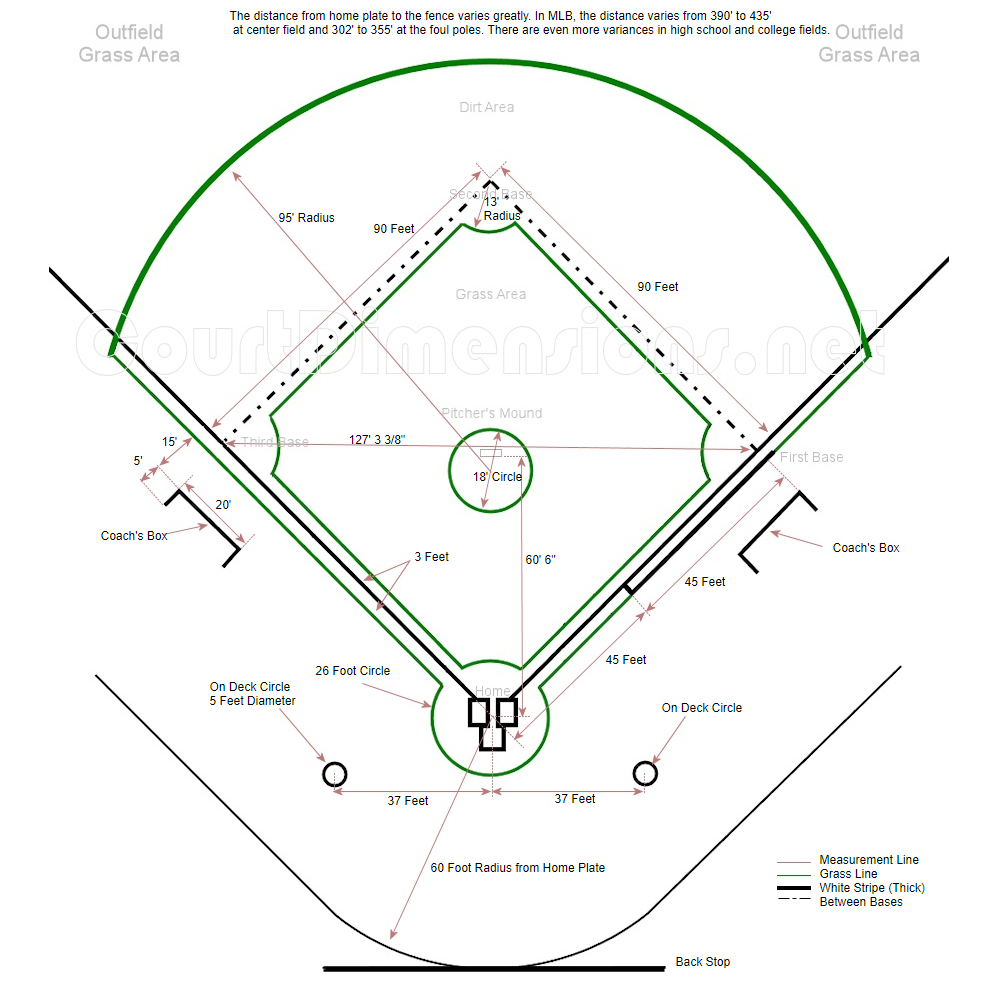
Image Source: www.courtdimensions.net
Fathoming the Baseball Infield Footprint
A baseball infield is a precisely defined area of the playing field. It’s where the action often happens – the ground balls, the bunts, the quick throws from the catcher. Calculating its total square footage involves several key components and some geometric principles. It’s more than just the dirt; it encompasses the bases, the pitcher’s mound, and the area surrounding them. When we talk about baseball infield dimensions, we’re referring to a specific layout that includes the diamond, the pitcher’s mound, and the surrounding dirt and grass areas leading to the outfield.
The Geometry of the Diamond
At the heart of every baseball infield is the “diamond.” This isn’t a literal diamond shape, but rather a square formed by connecting the four bases: home plate, first base, second base, and third base.
Measuring the Diamond’s Area
The distance between each base is crucial. For professional baseball (MLB), this distance is 90 feet. This means the diamond itself is a square with sides of 90 feet.
To find the area of a square, you simply multiply the length of one side by itself.
- Diamond Area = Side Length × Side Length
- Diamond Area = 90 feet × 90 feet
- Diamond Area = 8,100 square feet
This 8,100 square feet represents the area of the square formed by the base paths. However, the “infield” is larger than just this square. It includes the dirt surrounding the bases, the pitcher’s mound, and the transitional areas of grass that typically border the dirt.
Components of the Infield
Beyond the base paths, several other elements contribute to the overall infield square footage.
The Pitcher’s Mound
The pitcher’s mound is a raised circular area from which the pitcher throws the ball. Its dimensions are also standardized.
- Mound Diameter: 18 feet
- Mound Radius: 9 feet (Diameter / 2)
To calculate the area of the pitcher’s mound, we use the formula for the area of a circle:
- Area of Circle = π × radius²
- Area of Mound = π × (9 feet)²
- Area of Mound = π × 81 square feet
- Area of Mound ≈ 3.14159 × 81 square feet
- Area of Mound ≈ 254.5 square feet
This circular area is part of the infield’s total footprint.
Base Path Length and Foul Territory
The base path length is the 90 feet between each base in professional baseball. However, the infield extends beyond these lines. The foul lines themselves are boundaries. The area between the foul lines, from the edge of the outfield grass to home plate, is also considered part of the infield. This “foul territory” within the infield contributes additional square footage.
The Dirt Infield vs. The Infield Playing Area
It’s important to distinguish between the “dirt infield” and the broader “infield playing area.” The dirt infield typically refers to the prepared soil surface that encompasses the pitcher’s mound and the areas immediately around each base, often extending to the edge of the infield grass. The infield playing area, on the other hand, is a larger concept that can include the grass between the bases and the dirt cutouts.
Calculating Total Infield Square Footage (MLB Example)
Estimating the total infield square footage requires considering the diamond, the pitcher’s mound, and the surrounding dirt and grass. This isn’t an exact science because the exact shape and extent of the dirt infield and the transition to the outfield grass can vary slightly between stadiums. However, we can make a reasonable approximation.
A common way to visualize this is to consider the square formed by extending lines from first base to third base, and from home plate perpendicular to the pitcher’s mound. Then, consider the additional areas.
Let’s break down the approximate areas for a standard MLB infield:
- The 90-foot square diamond: 8,100 sq ft
- Pitcher’s Mound: ~255 sq ft
Now, consider the dirt area that surrounds these components. This area extends beyond the base paths. Imagine a larger square or a rounded shape that encompasses the dirt.
A widely cited approximation for the entire dirt infield and the immediate grass around it (often up to the grass line) is around 17,500 square feet. This figure accounts for:
- The 8,100 sq ft diamond.
- The pitcher’s mound.
- The dirt cutouts around bases.
- The areas between bases and the edge of the infield grass.
- The shape of the infield itself, which is not a perfect square but rather a pentagonal shape when you consider the extended foul lines and the curved edge of the outfield grass.
It’s crucial to note that this 17,500 sq ft is an approximation for the dirt and immediate surrounding grass often considered the “infield.” The total playing field size is much larger and includes the outfield.
Variations in Baseball Field Size
The size of a baseball field, and therefore its infield, can vary significantly depending on the league and age group.
MLB Infield Size
As discussed, a standard MLB infield is approximately 17,500 square feet, with the core diamond being 8,100 square feet. The base path length is 90 feet, and the pitcher’s mound size is standardized at 18 feet in diameter.
Little League Infield Size
Little League baseball uses smaller dimensions to accommodate younger players. The most common Little League field has a base path length of 60 feet and a pitcher’s mound distance of 46 feet from home plate.
- Little League Diamond Side Length: 60 feet
- Little League Diamond Area: 60 feet × 60 feet = 3,600 square feet
The total infield square footage for a Little League field will be proportionally smaller than an MLB field, likely in the range of 6,000 to 8,000 square feet, depending on how far the dirt and grass extend from the bases.
Softball Infield Size
Softball also has different dimensions than baseball. Fastpitch softball typically uses a base path length of 60 feet, similar to Little League baseball, but the pitcher’s mound is closer. Slowpitch softball can have even smaller base paths, often 50 or 55 feet.
- Fastpitch Softball Diamond Side Length: 60 feet
- Fastpitch Softball Diamond Area: 60 feet × 60 feet = 3,600 square feet
The total infield square footage for a softball field would also be in a similar range to Little League baseball, generally 6,000 to 8,000 square feet. The pitcher’s mound size in softball is typically smaller and flat, without the significant elevation of a baseball mound.
Comprehending Baseball Field Dimensions Holistically
When we talk about a “baseball field size,” it’s a broader term that includes both the infield and the outfield. The outfield dimensions are not as rigidly standardized as the infield, but they follow certain guidelines. The distance from home plate to the outfield fence can vary considerably, often ranging from 300 to 400 feet or more.
The infield’s role is distinct from the outfield. The infield is the domain of the infielders, where quick reflexes and accurate throws are paramount. The outfield is for the outfielders, who cover more ground and often make long throws.
Deciphering the Square Footage Calculation
To reiterate the breakdown for an MLB infield:
- The Diamond: This is the square formed by the four bases. With 90-foot base paths, it’s 90ft x 90ft = 8,100 sq ft.
- Pitcher’s Mound: A circle with an 18-foot diameter (9-foot radius) is approximately 255 sq ft.
- Surrounding Dirt and Grass: This is where the approximation comes in. This area includes the dirt cutouts around each base, the areas between the bases and the edge of the infield grass, and the generally rounded shape of the infield boundary. This expansive area adds significantly to the total.
Table: Key Infield Dimensions and Areas (Approximate)
| Component | Dimension (MLB) | Area (Approximate) |
|---|---|---|
| Base Path Length | 90 feet | N/A |
| Diamond Square Area | 90 ft x 90 ft | 8,100 sq ft |
| Pitcher’s Mound Diameter | 18 feet | 255 sq ft |
| Total Infield Area | ~17,500 sq ft |
Factors Influencing Infield Size
Several factors can lead to slight variations in the exact square footage of a baseball infield:
- Stadium Design: Different ballparks have unique architectural layouts, which can influence the shape and extent of the infield.
- League Regulations: While MLB has standards, minor leagues or amateur leagues might have slight variations in their official rules regarding infield boundaries.
- Groundskeeper Practices: The precise line where dirt meets grass can be maintained differently by groundskeeping crews, subtly affecting the measured square footage of the dirt infield.
- Foul Territory within Infield: The amount of foul territory within the infield area can also vary. Some fields might have more expansive foul areas directly behind first and third base.
The Importance of Infield Dimensions
The precise measurements of a baseball infield are not just for technical accuracy; they have a direct impact on the game itself:
- Base Path Length: A longer base path means players have more time to advance and more distance to cover when stealing bases or rounding bases. This favors faster runners.
- Pitcher’s Mound Size and Height: The mound’s size and elevation create a downhill angle for the pitcher, affecting the ball’s velocity and trajectory. Its proximity to home plate influences the batter’s reaction time.
- Infield Size: A larger infield means more ground for infielders to cover, potentially leading to more errors or requiring exceptional range from players like shortstops and second basemen. Smaller infields can favor hitters by making routine ground balls easier to handle and potentially leading to more doubles.
Relating Infield to Outfield Dimensions
While the infield is a precisely measured area, the outfield dimensions are more variable. The outfield fence marks the boundary of fair play. The distance to the outfield fence can vary significantly between different stadiums.
- Center Field: Often the deepest part of the outfield, distances can range from 380 to over 420 feet from home plate.
- Left and Right Field: These distances are typically shorter, often between 300 and 350 feet from home plate.
The total baseball field size is the sum of the infield area, the outfield area, and any foul territory beyond those. However, the question focuses specifically on the infield square footage.
Fathoming the Numbers: A Quick Summary
To summarize the key figures for a standard MLB infield:
- The core diamond area (square between bases) is 8,100 sq ft.
- The pitcher’s mound adds approximately 255 sq ft.
- The total infield area, including the dirt and immediate surrounding grass, is generally estimated to be around 17,500 sq ft.
These numbers provide a solid framework for understanding the physical space that constitutes the infield of a baseball field. Whether it’s an MLB game, a Little League match, or a softball competition, the dimensions of the infield play a crucial role in shaping the game’s dynamics.
Frequently Asked Questions (FAQ)
Q1: What is the exact square footage of a baseball infield?
A1: The exact square footage can vary slightly, but a standard MLB infield is approximately 17,500 square feet. This includes the diamond, pitcher’s mound, and surrounding dirt and grass.
Q2: How is the area of a baseball diamond calculated?
A2: A baseball diamond is a square with bases 90 feet apart (in MLB). Its area is calculated by multiplying the side length by itself: 90 ft x 90 ft = 8,100 sq ft.
Q3: Does the outfield count towards the infield square footage?
A3: No, the outfield is a separate area of the baseball field and is not included in the infield square footage calculation.
Q4: Are Little League infield dimensions the same as MLB?
A4: No, Little League infields are smaller. They typically have 60-foot base paths, making the diamond area 3,600 sq ft, and a smaller overall infield square footage compared to MLB.
Q5: What are the standard baseball infield dimensions?
A5: The key dimension is the 90-foot base path length for MLB. The pitcher’s mound is 18 feet in diameter and raised. These dimensions define the core infield layout.