
A typical professional baseball field, from foul pole to foul pole and all the way to the deepest parts of the outfield, can range from 2.5 acres to over 3 acres, translating to roughly 108,900 to 130,680 square feet. This vast expanse is meticulously designed, but the exact square footage varies depending on the specific dimensions of each ballpark.
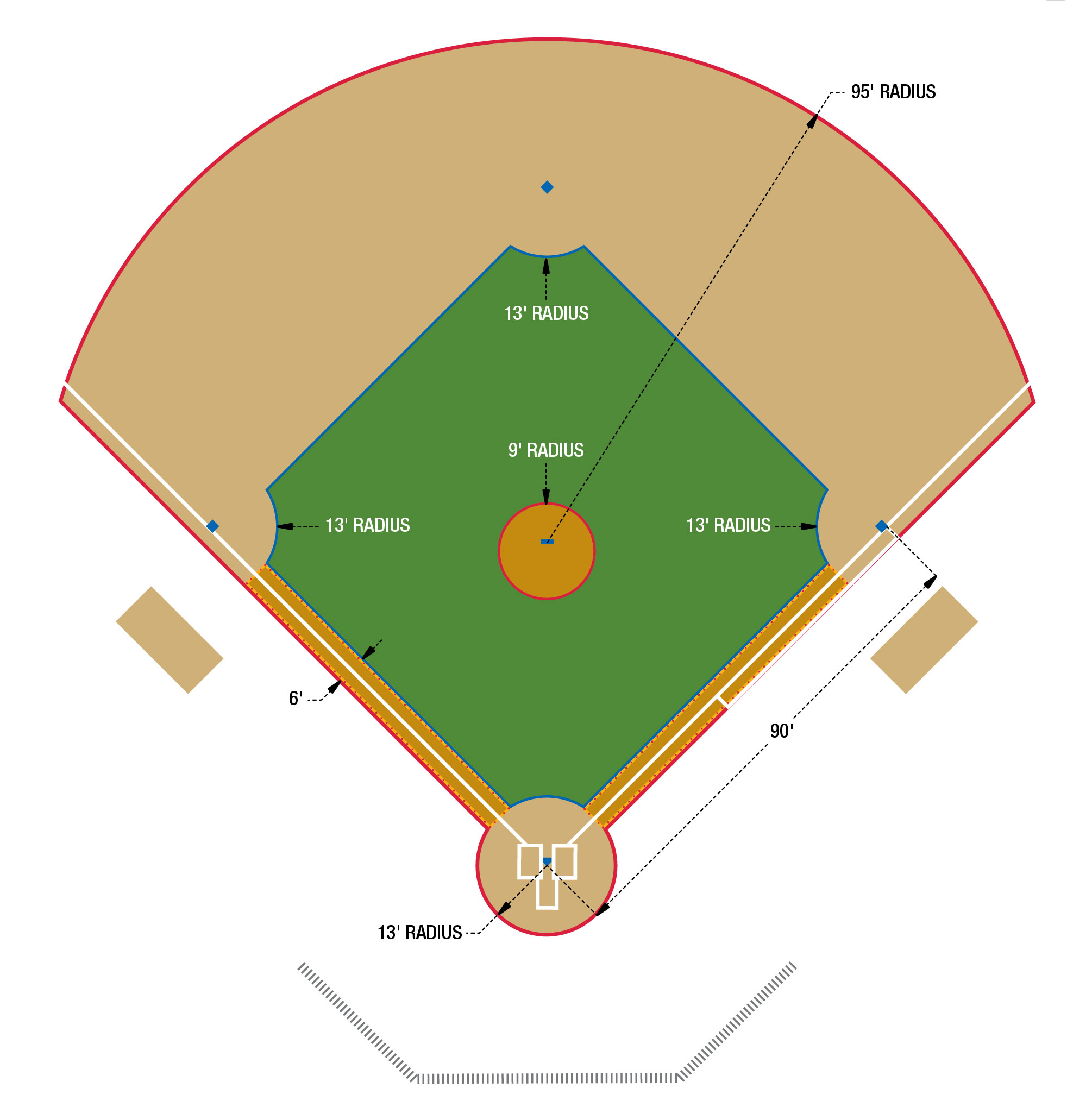
Image Source: ballfields.com
Delving into Baseball Field Dimensions
When we talk about a baseball field, we’re not just talking about the manicured grass and dirt. We’re encompassing a significant area that includes the playing surface, the foul territories, and often the spectator areas and the stadium structure itself. The question of “how big is a baseball field?” opens up a discussion about the detailed baseball field dimensions that create this iconic sporting venue. It’s a complex interplay of carefully measured lines, distances, and areas that define the game we love.
The Baseball Diamond Size Explained
At the heart of every baseball field lies the baseball diamond size. This is the infield area where the magic of pitching, hitting, and fielding happens. It’s a square with bases 90 feet apart for professional and college games. However, the “diamond” itself refers to the dirt area, which is typically a 90-foot square enclosed by the baselines.
Key Measurements of the Infield:
- Bases: 90 feet apart (professional and college)
- Pitcher’s Mound: A raised circle, 60 feet 6 inches from home plate to the back of the pitching rubber.
- Home Plate to Foul Poles: The distance to the foul poles is crucial for determining the outfield boundaries and varies significantly from park to park.
Infield Size Baseball: More Than Just the Diamond
While the 90-foot square defines the core of the infield size baseball, the infield extends beyond this. It includes the area between the foul lines extending out to the outfield grass, as well as the batter’s boxes, catcher’s box, and the on-deck circles.
Table 1: Standard Infield Dimensions (Professional Baseball)
| Feature | Measurement |
|---|---|
| Base Path Length | 90 feet |
| Pitcher’s Mound Diameter | 18 feet |
| Pitcher’s Rubber Length | 24 inches |
| Home Plate Width | 17 inches |
| Base Size | 15 inches x 15 inches x 3 inches |
Outfield Area Square Footage: The Expansive Green
The outfield area square footage is where the vast majority of the field’s size comes into play. This is the sprawling expanse of grass that stretches from the infield to the outfield walls. The dimensions of the outfield are not standardized like the infield. This is what gives each ballpark its unique character and strategic challenges.
Factors Influencing Outfield Size:
- Foul Lines: The distance from home plate to the foul poles.
- Center Field Depth: The deepest part of the outfield.
- Outfield Wall Shape: The curvature and height of the outfield walls.
These variations mean that the outfield area square footage can differ dramatically between stadiums. Some fields have shallow outfields, while others boast immense, sprawling outfields that test the speed and arm strength of outfielders.
MLB Field Dimensions: The Pinnacle of Play
MLB field dimensions are the benchmark for professional baseball. While the infield is largely standardized, the outfield dimensions are where the true variation lies. This is a result of historical development, architectural constraints, and the desire to create unique playing environments.
Historical Context of MLB Field Dimensions:
Early baseball fields were often built in existing urban spaces, leading to irregular shapes and sizes. As stadiums became more sophisticated, designers still aimed for a certain aesthetic and a balance of offensive and defensive advantages. This has led to the diverse array of outfield dimensions we see today.
Little League Field Size: A Different Ballgame
It’s important to distinguish between professional fields and those for younger players. A Little League field size is considerably smaller, designed for children to learn and enjoy the game.
Table 2: Comparison of Baseball Field Sizes
| Field Type | Base Path Length | Outfield Fence Distance (Typical) | Acreage (Approximate) | Square Footage (Approximate) |
|---|---|---|---|---|
| Little League | 60 feet | 200-225 feet | 0.5 – 0.75 | 21,780 – 32,670 |
| High School | 80 feet | 300-350 feet | 1.5 – 2.0 | 65,340 – 87,120 |
| MLB | 90 feet | 300-410+ feet | 2.5 – 3.0+ | 108,900 – 130,680+ |
Softball Field Dimensions: A Sister Sport
While often played on similar grounds, softball field dimensions differ from baseball. The bases are closer, and the outfield is generally shorter.
Table 3: Key Softball Field Dimensions (Fastpitch)
| Feature | Measurement |
|---|---|
| Base Path Length | 60 feet |
| Pitcher’s Plate to Home Plate | 43 feet (fastpitch) |
| Outfield Fence (Typical) | 200-220 feet |
Calculating the Total Baseball Park Square Footage
The baseball park square footage encompasses more than just the playing field. It includes the entire stadium structure, concessions, restrooms, concourses, and potentially parking areas. However, when people ask “how many square feet in a baseball field?”, they are usually referring to the playing area and its immediate surroundings.
Acreage of a Baseball Field: From Square Feet to Acres
To convert square footage to acreage, we use the conversion factor: 1 acre = 43,560 square feet.
- A field of 108,900 square feet is equal to 108,900 / 43,560 = 2.5 acres.
- A field of 130,680 square feet is equal to 130,680 / 43,560 = 3.0 acres.
Therefore, the baseball field acreage typically falls within this range for professional venues.
Factors Affecting Total Square Footage:
- Foul Territory: The amount of space between the foul lines and the stadium seats or outer boundaries.
- Stadium Design: The footprint of the stadium itself.
- Amenities: Inclusion of practice fields, team facilities, etc.
Deciphering the Variances in Outfield Distances
The beauty and challenge of baseball often lie in the unique characteristics of each ballpark’s outfield. This is why there isn’t a single answer to “how many square feet in a baseball field?”
Examples of Notable Outfield Dimensions:
- Fenway Park (Boston Red Sox): Famous for its short left-field line (310 feet) and incredibly deep center field (420 feet), creating a unique playing experience.
- Coors Field (Colorado Rockies): Known for its expansive outfield, with distances that can reach over 420 feet to straightaway center field.
- Oracle Park (San Francisco Giants): Features a famous bay beyond the right-field wall, with varying distances to the wall that can be tricky for hitters.
These variations in outfield area square footage directly impact the game, influencing strategies for hitters, pitchers, and fielders alike. A hitter might try to pull the ball towards a short porch, while an outfielder in a deep park needs exceptional speed and arm strength.
Interpreting the Data: What Does It All Mean?
The raw numbers of square footage and acreage are important, but they don’t tell the whole story. The strategic layout of the field, the dimensions of the infield size baseball, and the expansive outfield area square footage all contribute to the game’s drama.
Strategic Implications of Field Dimensions:
- Pitching: Pitchers might have to adjust their approach based on the ballpark’s dimensions, especially concerning how fly balls carry.
- Hitting: Hitters can target specific areas of the outfield to maximize their chances of extra-base hits or home runs.
- Fielding: Outfielders must have a keen sense of the ballpark’s boundaries and the typical trajectory of fly balls.
The baseball diamond size itself is a constant, but the interplay between the infield and the outfield is what makes each park a living entity within the game.
Comprehending the Scale: A Visual Approach
To truly grasp “how big is a baseball field?”, it helps to visualize. Imagine:
- The precise 90-foot squares of the infield.
- The broad green carpet of the outfield stretching out before you.
- The towering outfield walls that mark the ultimate boundary.
Each element is measured and placed to create a specific environment for competition. The baseball park square footage is a testament to the planning and engineering that goes into creating these sporting cathedrals.
Fathoming the Complexity of Baseball Field Acreage
The baseball field acreage is not a simple calculation. It’s a measure of the entire playing space, including foul territory. This foul territory can be quite substantial, providing a buffer zone and influencing how a game is played.
Foul Territory and its Impact:
- Defense: Extra foul territory can make it harder for infielders and outfielders to make plays on foul balls.
- Spectatorship: In some parks, foul territory is minimal, bringing fans closer to the action, while in others, it’s more expansive.
The amount of foul territory directly contributes to the overall baseball park square footage.
The Evolution of Baseball Field Dimensions
Over time, MLB field dimensions have seen subtle shifts and major alterations. As stadiums have been rebuilt and renovated, designers have had opportunities to create more standardized or, conversely, more unique playing surfaces.
Modern Trends in Field Design:
- Player Safety: Efforts are often made to ensure player safety, which can influence the placement of walls and the elimination of certain architectural quirks.
- Fan Experience: Ballpark designs increasingly prioritize the fan experience, which can impact the layout and overall size of the playing area.
Little League Field Size vs. Professional Standards
The differences between a Little League field size and MLB field dimensions highlight the adaptive nature of the sport. As players grow and develop, the field scales up with them, providing appropriate challenges at each level. This ensures that the game remains accessible and enjoyable for all ages.
Softball Field Dimensions: A Related but Distinct Layout
Similarly, softball field dimensions cater to the specific needs of softball players, with closer bases and shorter outfield fences. These differences, while seemingly minor, significantly alter the pace and strategies of the game compared to baseball.
Frequently Asked Questions About Baseball Field Size
Q1: What is the standard distance between bases in professional baseball?
A1: The standard distance between bases in professional baseball is 90 feet.
Q2: How large is a typical MLB baseball field in acres?
A2: A typical MLB baseball field, including outfield and foul territory, can range from 2.5 to over 3 acres.
Q3: Does the size of a baseball field affect the number of home runs hit?
A3: Yes, the dimensions of the outfield, particularly the distance to the outfield walls, can significantly impact the number of home runs hit. Shorter fences tend to lead to more home runs.
Q4: Is there a minimum or maximum size for an MLB baseball field?
A4: While there are guidelines for MLB field dimensions, the exact measurements, especially in the outfield, can vary. There isn’t a strict minimum or maximum square footage mandated for every park, allowing for unique designs.
Q5: How does the infield size of a Little League field compare to an MLB field?
A5: A Little League infield is smaller, with bases typically 60 feet apart, compared to the 90 feet in MLB. This makes the infield size baseball much more manageable for younger players.
Q6: Are softball field dimensions the same as baseball field dimensions?
A6: No, softball field dimensions are different. Softball fields generally have closer bases and shorter outfield fences than baseball fields.
Q7: What is meant by “foul territory” in baseball?
A7: Foul territory refers to the area outside the foul lines but within the confines of the stadium or playing area. This space contributes to the overall baseball park square footage.
Q8: How many square feet are in an acre?
A8: There are 43,560 square feet in one acre.
Q9: Why do MLB stadiums have different outfield dimensions?
A9: Differences in MLB field dimensions are due to historical factors, architectural design choices, and the desire to create unique playing environments for each stadium.
Q10: How is the outfield area square footage calculated?
A10: The outfield area square footage is calculated by measuring the area of the grass and dirt from the edge of the infield out to the outfield wall, following the contours of the playing field.